The craft
How our wall baskets are made
No looms, no moulds, no machines. Every basket is built by hand from the centre outward, one coil at a time, by women artisans in South Asia using a technique passed down through generations.
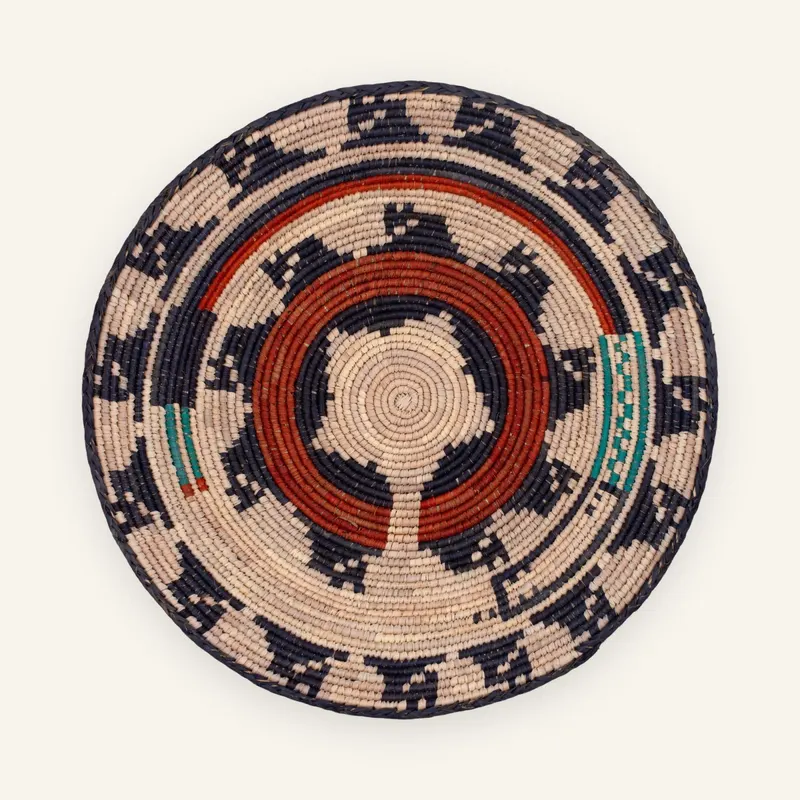
Two materials, thousands of stitches
Grass forms the core. Gathered locally and dried, it gives each coil its body and keeps the basket light.
Date palm leaf is split into thin strips that wrap and bind the grass. Natural strips give the warm beige ground, and dyed strips make the black, rust, indigo, turquoise and other colours of the patterns.
Because the colour is woven in rather than printed or painted on, it lasts as long as the basket.
Step by step
From a bundle of grass to a finished basket
1. Prepare the fibres
Grass is gathered and dried. Date palm leaves are split into thin, even strips, and some are dyed for the pattern.
2. Start the centre
A small bundle of grass is wrapped tightly in palm strip and curled into the first tiny ring.
3. Coil and stitch
Fresh grass is fed into the bundle as it is wrapped, and each new coil is stitched to the one before.
4. Weave the pattern
Dyed strips are swapped in and out to build the geometric design ring by ring.
5. Shape and finish the rim
The weaver controls the angle of each coil to make a flat plate or a deeper bowl, then finishes with a neat rim.
6. Inspect and pack
Each finished piece is checked for shape, stitching and colour, cleaned, labelled and nested for export.
Why no two baskets are identical
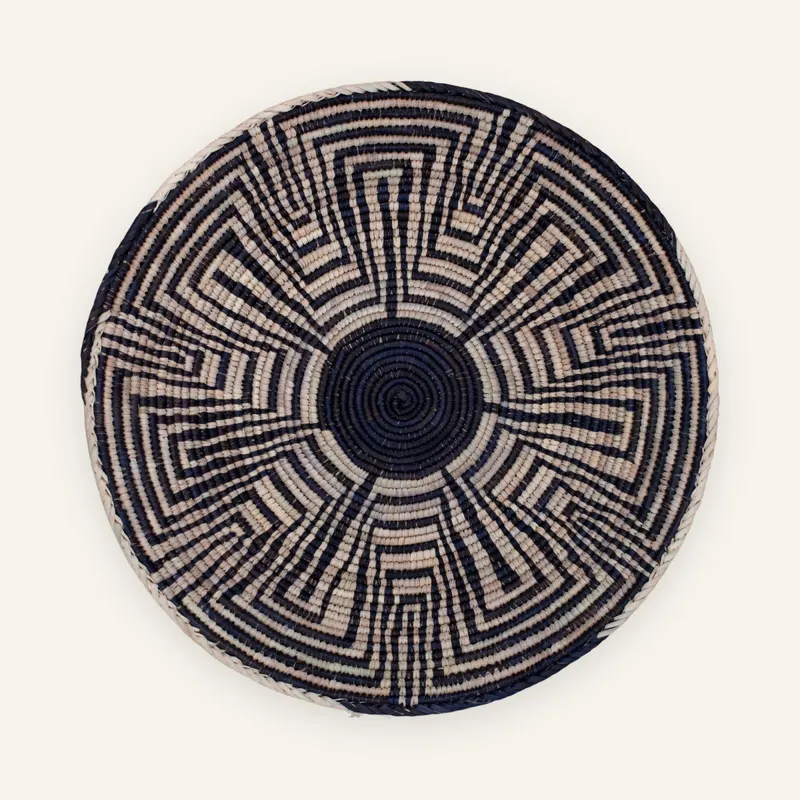
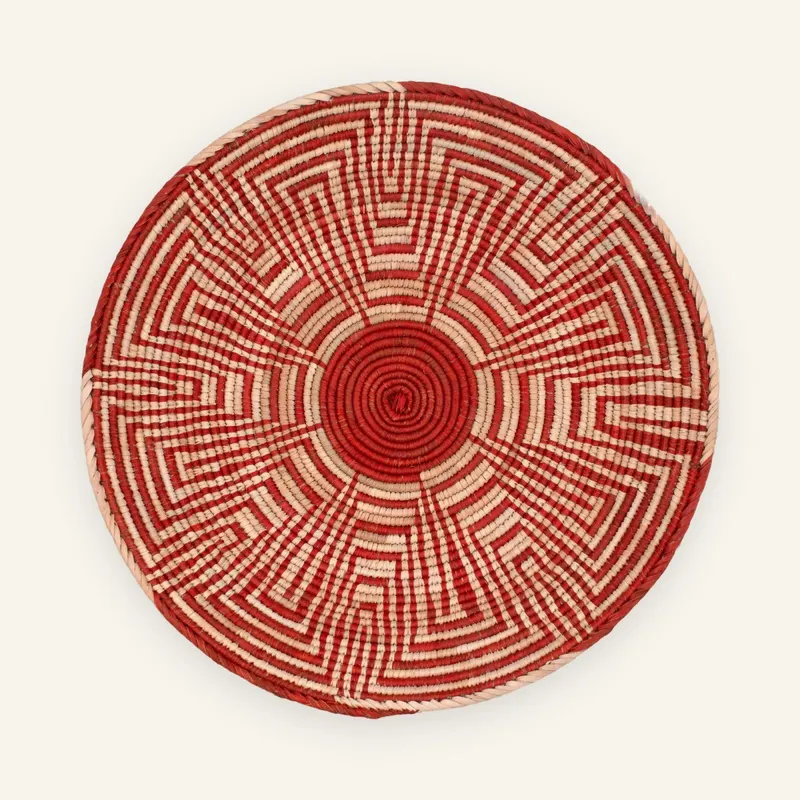
A weaver makes hundreds of small decisions in every piece: how much grass to feed in, how tightly to wrap, exactly where a colour change falls. That is what gives handmade baskets their life, and it is also why two pieces of the same design are never exact copies.
- Colour placement can shift slightly around the spiral
- Diameter can vary by a centimetre or two
- Natural fibres vary in tone from batch to batch
We check every piece before it is packed, so the variation stays within the character of the craft and never becomes a defect.
Where the designs come from
Coiled basketry is one of the oldest crafts in the world. The geometric designs in our collection are inspired by the basket traditions of the American Southwest, where Indigenous weavers have coiled willow, yucca and grasses into baskets for thousands of years. Decades ago, books of these designs reached a village in South Asia, and the women there began reinterpreting them with their own grass-and-palm technique and their own colours.
Our baskets are not made by Native American artisans, and we never market them as such. They are an original South Asian expression of a cross-cultural exchange, and we describe them honestly on every page and every label.
Ready to stock handwoven wall baskets?
Tell us your market and quantities. We’ll reply within one working day with wholesale prices, availability and a shipping quote to your door.