Buying woven wall baskets wholesale: a retailer’s guide
MOQs, samples, landed cost, quality checks and lead times: what to ask a supplier before your first order.
Read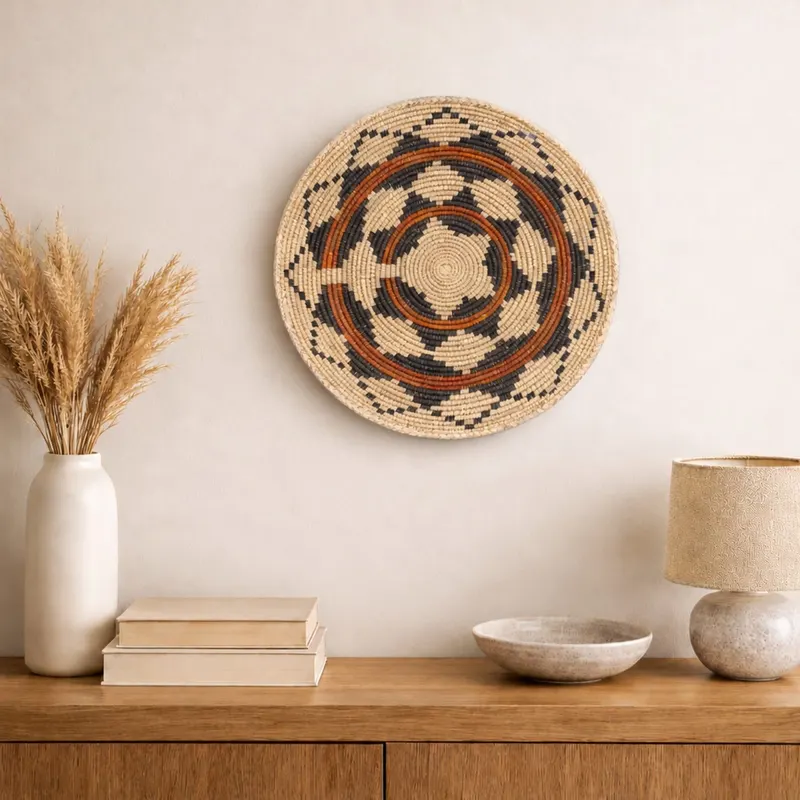
Woven wall baskets are one of the easiest ways to add texture to a room. They are light, inexpensive to hang and forgiving if you change your mind. But a random cluster rarely looks as good as a planned one. This guide covers the hardware, the spacing and five layouts that work, whether you’re decorating your own wall or merchandising a shop display.
In this guide
Coiled grass-and-palm baskets are very light, even at 40 cm across, so you don’t need heavy-duty fixings. Choose one of these:
Avoid hanging baskets in permanently damp spots such as directly above a shower, or where strong afternoon sun hits them all day. Natural fibres and dyes last far longer in normal indoor light.
Aim for the centre of the arrangement to sit at about eye level, roughly 145–155 cm from the floor. Above a sofa or console, leave 20–30 cm between the furniture and the lowest basket, so the group reads as part of the furniture rather than floating away from it.
Keep gaps between baskets consistent, usually 5–10 cm. Tight spacing looks deliberate. Wide, uneven gaps look accidental.
One large basket (35–40 cm) slightly off-centre, two medium baskets around it and two smalls to finish. This is the most forgiving layout and works above sofas and beds. Use a 40 cm Classic plate or a Premium plate as the anchor.
Baskets of the same or similar size in a straight line, centres aligned. Calm and modern, and good for long walls or above a sideboard. It works best with three or four black-and-natural Classic plates.
A loose, organic cluster that mixes all four sizes. Start with the largest pieces in the middle and work outward, using Mini plates to fill the gaps. Lay it out on the floor first and photograph it.
Three baskets stacked vertically, large to small. Perfect for narrow walls, between windows or along a stairwell.
Sometimes one basket is enough. A densely patterned Premium plate above a console table does the work of a framed print, at a fraction of the price.
The simplest rule: one or two colour families per wall. Black-and-natural pieces mix with everything. Earth tones mix with blues. Multicolour designs look best as one or two hero pieces among calmer patterns. Repeat each colour at least twice across the arrangement so the eye moves around the wall.
Odd numbers (3, 5, 7) are easier to balance than even ones, and a mix of three sizes almost always looks better than one size repeated.
Customers struggle to picture a gallery wall from single products on a shelf. Showing a finished wall in store or online, and selling it as a bundle, removes that guesswork. Order a mix of categories (one large, two or three medium, a few minis) and you can merchandise complete walls straight from the carton.
MOQs, samples, landed cost, quality checks and lead times: what to ask a supplier before your first order.
ReadHow coiled, wicker, rattan and seagrass baskets differ in technique, look and durability, and which is best for wall décor.
ReadA plain-language checklist: HS code 4602, origin labels, plant-material rules, Incoterms and duty preferences.
ReadTell us your market and quantities. We’ll reply within one working day with wholesale prices, availability and a shipping quote to your door.